
You open a cannabis lab report and meet THC, THCA and total THC. Three similar names. Three different numbers. Suddenly the label has become the group project where nobody explains their role.
The extra letter matters. Understanding it helps explain the arithmetic on a Certificate of Analysis, or COA, without treating a percentage as a prediction of your experience.
THCA and delta-9 THC are different compounds
THCA is the acidic precursor to delta-9 THC. During a chemical change called decarboxylation, THCA loses carbon dioxide and can become THC. Heat can drive that change. This explains why a report may measure both the precursor and the THC already present.
Because carbon dioxide leaves the molecule, equal starting masses of THCA and THC are not interchangeable. The conversion factor 0.877 accounts for their different molecular masses. It is not a rating of quality, a recommended amount to consume, or a promise that 87.7% will reach your bloodstream.
USDA: explanation of the THCA-to-THC molecular-mass conversion
The label math, without the drama
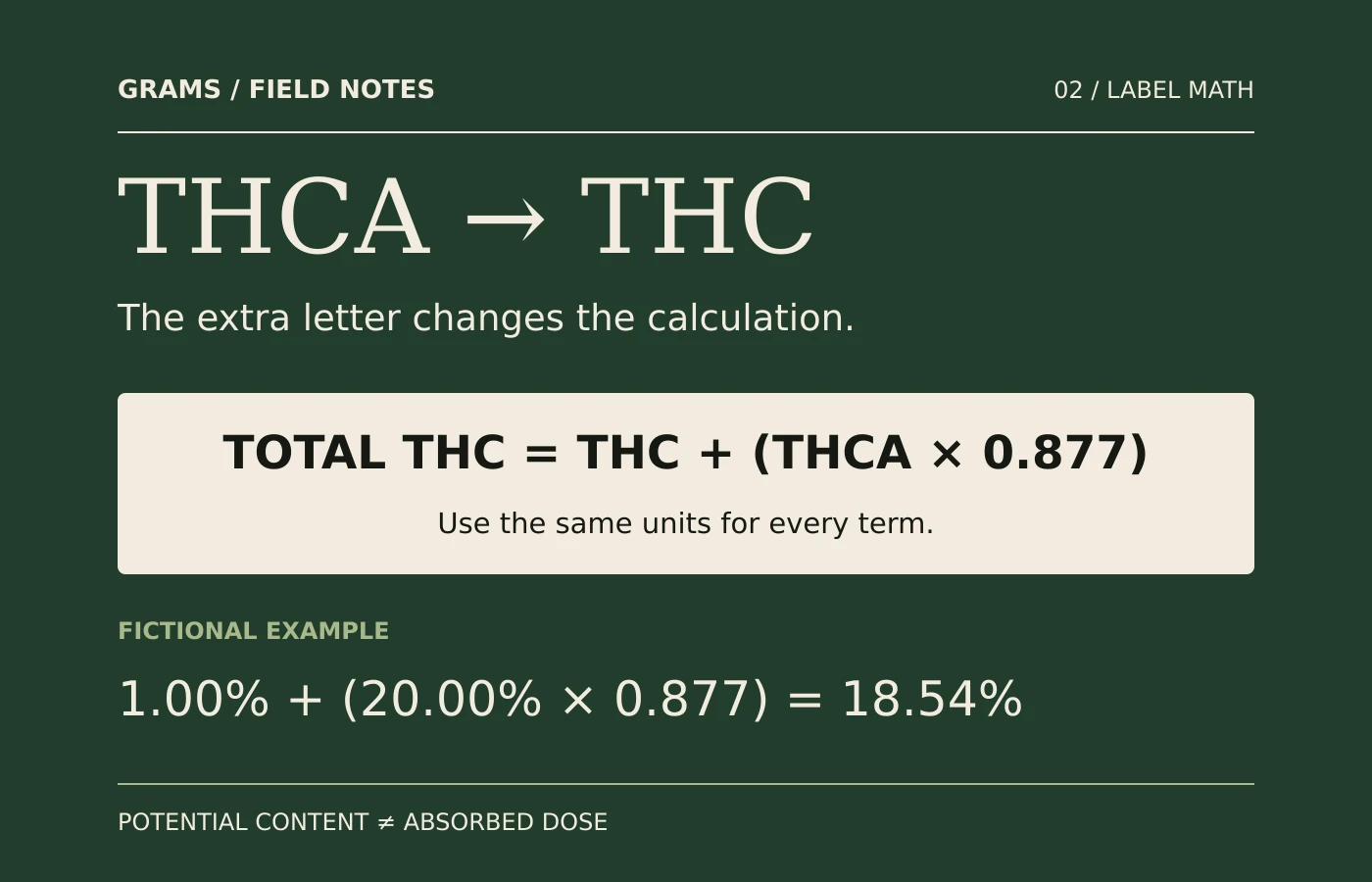
New York OCM’s packaging guidance gives this calculation: total THC = THC + (THCA × 0.877). Keep the units consistent when reading it.
| Reported or calculated value | Amount |
|---|---|
| Delta-9 THC | 1.00% |
| THCA | 20.00% |
| THCA contribution: 20.00 × 0.877 | 17.54% |
| Calculated total THC: 1.00 + 17.54 | 18.54% |
Simply adding 1% and 20% would miss the mass adjustment. Adding THCA to a number already labelled total THC would count its contribution twice. The heading above the number is doing real work here.
New York OCM: current packaging and labeling guidance
A calculation has limits
Calculated total THC describes potential THC content under the formula. It does not measure what someone actually absorbs. It also does not tell you whether a product is suitable for an individual.
When two numbers look inconsistent, first check the analyte name, units and batch identifier. A percentage, a milligram amount and a per-package total are different descriptions. Comparing them without their headings is like comparing a temperature with a subway arrival time: both are numbers, but the argument goes nowhere.
Related: how to read a Certificate of Analysis