
Some smells politely enter a room. Cannabis occasionally arrives like it already knows the landlord. That recognizable skunky note has a chemical explanation—and terpenes don’t get to take all the credit.
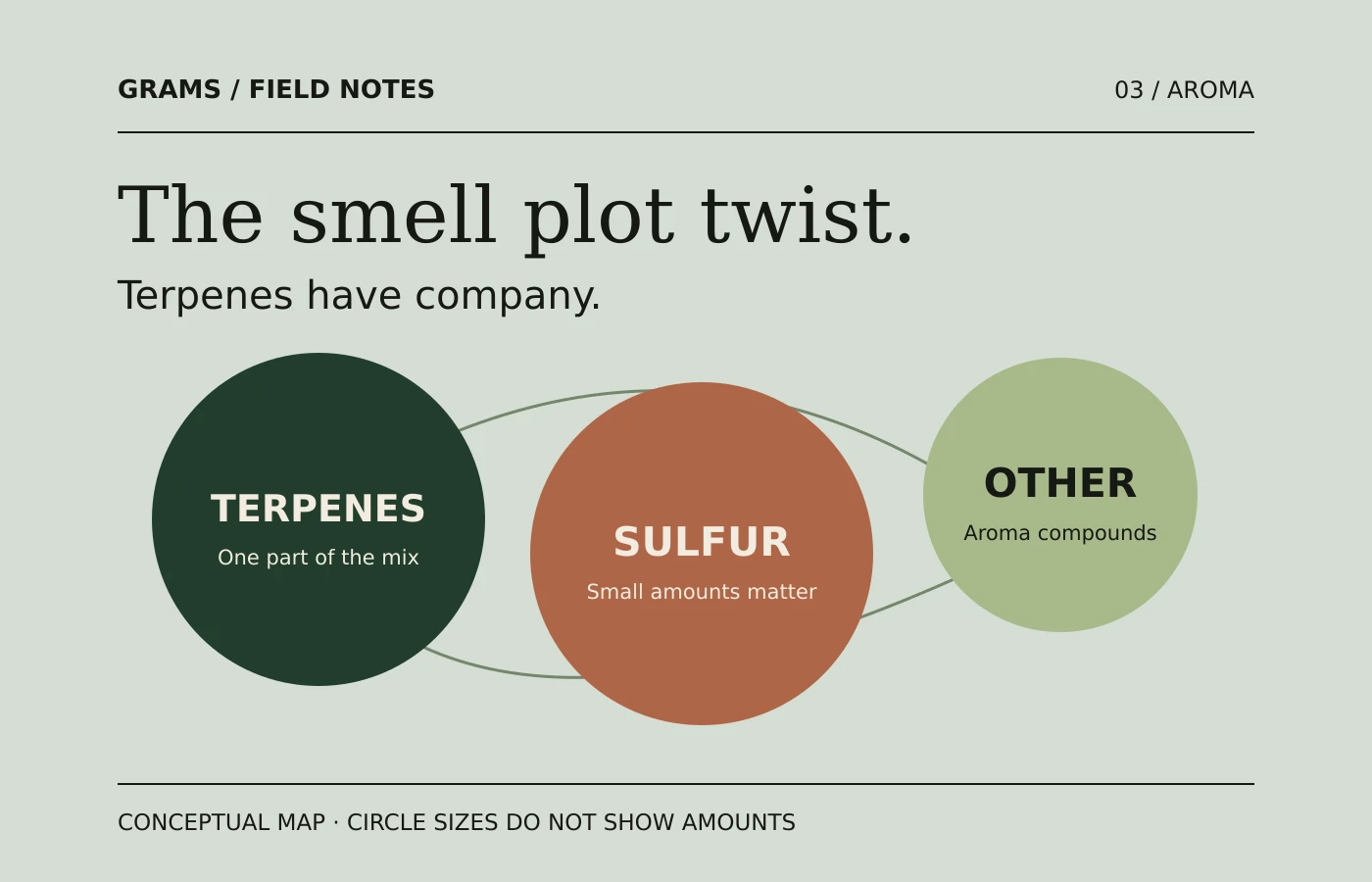
Our terpene guides cover part of the aroma story. Researchers have also identified compounds present in much smaller amounts that can make a surprisingly large contribution to what people smell.
Meet the sulfur compounds
A 2021 ACS Omega study investigated the skunk-like aroma of cannabis. The researchers identified a family of volatile sulfur compounds and found that one, 3-methyl-2-butene-1-thiol, was particularly strongly associated with that smell across 13 cultivars.
Yes, the name sounds like a Wi-Fi password. The useful part is simpler: a sulfur-containing molecule can have a powerful aromatic signature. A compound does not need to make up a large share of a sample to be noticeable to the nose.
The researchers also observed changes in these compounds over time in their plant and storage experiment. That finding concerns the samples and conditions they studied; it is not a universal freshness countdown for every container.
Original research: volatile sulfur compounds in cannabis (ACS Omega, 2021)
The aroma cast gets bigger
In a separate 2023 study, researchers analyzed 31 cannabis rosin extracts and compared their chemistry with sensory assessments. Minor compounds outside the terpene family were associated with distinctive sweet or savory aromas. The work included sulfur compounds connected with citrus or tropical notes, as well as other odor-active molecules.
These were extracts, not a survey of every flower product. Still, the findings give us a reason to be careful with one-compound explanations. A familiar smell can be a mixture, with several contributors sharing the stage.
Original research: minor compounds and cannabis aroma differences (ACS Omega, 2023)
What the nose cannot tell you
Our takeaway from these aroma studies: a short terpene list is not a complete inventory of everything contributing to a smell. That also means “smells strong” is not a measurement of THC, a contamination test or evidence of a medical benefit. Those are different questions requiring different evidence.
Think of an aroma description as a useful observation, not a laboratory verdict. Your nose can notice a plot twist. It cannot issue the certificate.
Related: an introduction to cannabis terpenes